I’ve been sick since Jan 1st which, as I write, is thirteen days. There are quite a few winter viruses flying around and this one has struck down the whole family and has left me quite unable to do just about anything.
Surprisingly it has even affected my ability to write words. What I mean is that the virus seems to have disconnected my brain from my hands and the keyboard. I can’t seem to get my fingers to write, correctly, the words I have in my front of mind. See, even that sounds weird.
Anyway, the point is I have not been enthusiastic for January because I’ve spent most of it in bed struggling to even think straight and I should be enthused because this Jan sees the paperback publication of my Quint novel. Thursday Jan 16th to be precise. It’s been almost a year since the hardback came out and I hope the paperback does just as well (I personally don’t buy hardbacks and I know I would wait for the smaller version). It’s already been featured in The Times for their best paperbacks of January so that’s a good start.
But I really need this to be a success, mainly because I’ve never written a novel like this before, one that came from such a passionate devotion to a movie from my childhood which I’ve carried with me ever since. I don’t think any of my works have been so personal. That’s why I need it to succeed.
So if you know any JAWS fans who might benefit from my literary acknowledgement to the JAWS phenomenon please send them my way. And it’s a really, really good book.
My penny in the discussion of AI with regards to writing isn’t new or different philosophically but I do have an opinion.
I’ve been following the AI train for quite a while because I’m middle aged and I’m like that Back To The Future meme: “Hey, I’ve seen this one.”
Like most things in this first quarter of the 21st century (I myself being born in the second Elizabethan age of the late 1900’s) it’s a partial scam.
The fourth industrial revolution is supposed to be: medicine, green and technology. That’s a generalisation but includes AI, its forms. and automation.
Like all frontiers of investment and development for every actual genius making a single sustainable leap there’s a thousand carpet baggers and snake oil hawkers pulling in gullible punters (investors). These, as tradition and nature shows, will be the most colourful and loudest showmen. This, combined with the grifter’s idiom that no-one likes to admit they’ve been fooled and the strange conceit that billionaires cannot be idiots or believe themselves capable of being duped like the rest of us, because somehow you can’t be dumb and rich, is the point we’re at now.
In a very short time AI, instead of being the Ouroboros of death and birth, has become the dog chasing its own tail.
At our current stage AI is eating itself, and, like the dog chasing its own tail, it’s also eating its own vomit.
Initially the concept was that AI would consume the world’s data, with the help of human programmers, and generate results from that information. Eventually it won’t need the human element, much like no human involvement is made in programming chips any more, the chips make the future chips themselves because they have gone beyond the programmer.
Actually, that’s quite worrying in itself.
The programmers are no longer capable of making the chips or the code. It’s been automated past their ability (by their own intention) to an almost quantum realm. We taught a rock to think and replicate.
When you see a guy in a leather jacket and jeans on stage introducing the next generation GPU or chip none of his or his team’s ideas were on a drafting table or in any development other than a language of code they can no longer read. A GPU created that GPU. And, because the coding in its development doesn’t consider heat or resources (because its a rock that thinks on a level outside the earth) all the GPU wants is more power and energy, and so the data centres and servers running the show also only require more power and energy until we find ourselves in the situation where water is rationed in Taiwan because the factories require the water to cool the chips making the chips rather than the people living and farming outside it. And don’t forget the heat coming out of these fields of data servers warming up the planet nicely and sucking all the energy resources. But your TV on standby is the problem.
Yeah, but what’s this got to do with writing or art?
Well, it goes back to the dog chasing its own tail. I don’t think anyone considered the circumstance that because the AI data would start to outweigh the human data the AI would start to regurgitate its own input. It’s getting worse but unable to recognise it’s getting worse because it’s using its “correct” information that it created badly in the first place.
Pure digression here but let’s take video games as an example.
Star Wars Outlaws just came out, a triple AAA game. A 2024 game.
Red Dead Redemption 2 came out in 2018.
You can look at comparisons of these two games on YouTube.
I guarantee that AI was involved in developing Outlaws because there is no way a human would program some of the flaws in that game. Or programmers have somehow gotten worse.
The concept is great, it looks good, but Pooh Sticks handles its environment and mechanics better.
RDR2 is beloved, years later. Once, in Red Dead, I randomly saw a fox chase and catch a squirrel. I shot the fox. I was able to go to the fox, the squirrel dead in its mouth, take the squirrel from its mouth and put it in my satchel and then skin the fox. In Outlaws you can walk through a speeder bike and punch storm troopers to death in a crowded room of other storm troopers. You can’t carry a weapon down a ladder.
In the past month alone we have watched supposedly huge games/films be universally mocked and fail at the cost of billions of dollars because a human possibly didn’t even draw the concept art let alone make them without some AI. Video games, movies, books, art, cannot just be concepts to be extrapolated. Yes, it can be done. Anyone can write a book. It doesn’t mean it’s a good book, and hell there are thousands of shit books, but surely you don’t want to read shit books? You don’t want to play shit games or watch shit movies.
I think this is what they forget. I’m not saying AI can’t write a good book or make good art or music but shouldn’t AI be doing the things we don’t want to do to give us, the humans, the time and desire to write the books and make the music? Shouldn’t that be the end goal?
I heard someone say recently, “Why would I bother to read a book no-one bothered to write?” And that’s almost exactly it. Why would I value a picture no-one painted or show up to a film no-one cared to make?
They also don’t consider (and the AI can’t) that humans are both fickle and discerning and contradictory and have been forever and do many, many things that don’t make sense or have purpose, probably because they don’t make sense or have purpose.
We domesticate wild animals and keep them in our homes, we both enjoy being entertained by things that make us laugh and make us cry, we eat food not for fuel but for pleasure, we like to do exhausting things and also like to do absolutely nothing.
No-one ever imagined that we would be content to watch a film on a device in our hand. They imagined we wanted bigger and bigger TVs, we wanted to fold them up like a map for some reason or have them appear in front of us on the wall and be invisible the rest of the time. No we didn’t, you didn’t ask. You may have asked a five year old or your rich mate but you didn’t ask us. We boil water over a flame the same as we’ve always done.
We’re more simple than they want, or need, us to be.
The smart device is a great example. We’re in love with them for about a week and then we just use them as egg-timers or alarm clocks. Not enough of us are going to use an app to brush our teeth but it’s there if you want it. You can subscribe.
AI will write books and screenplays, as well as most people. Not good, talented, skilled people, and it may never do so if it continues the model of eating it’s own infinite data to generate them or just steals actual people’s.
I can see it already in some TV and films. There’s dialogue and exposition that shouldn’t be there. A good human writer will know when silence is better, when a look is better, when the actor needs to project instead. Look for it: You can spot the AI because it fills in the gaps. It tells, doesn’t show. It fast travels, puts people or things exactly where they need to be with no step how they got there, only that they are needed and all with way, way too much dialogue, like a lawyer striving to obfuscate a jury.
It does the same in books. It leaves no gap for interpretation, says everything, tells everything, has no experimentation or craft, subtlety or nuance. Mediocre books and films, plays and art have always existed. Why do we want to emulate that?
Maybe it’s because, unwittingly or by design, AI intends to create a future without satire or parody or alternative commentary. It can’t emulate these things so it discards them as it’s not in its own data that it has consumed. It doesn’t know how lazy, contrary and contradictory we are because it doesn’t know we want to be like that sometimes or that we are like that.
And it’s not about creating. It’s about cost.
Capitalism no longer requires that the end user is satisfied for it to achieve success, those days are gone, companies are no longer interested in pleasing the consumer with the best service or product. The goal is monopolies, universal ownership and anti competitive logic, so there is no choice in service, only that the service was delivered. They got your money because you bought a pair of shoes from a choice of five companies all owned by the same asset firm who also happen to be the majority shareholders. (My coat example at the end of this piece).
The dream is to have nobody being paid to be working in the warehouse, nobody to be paid for manufacturing, nobody to be paid for delivering. Robots to do it all and a robot will fix the robot when it breaks.
Companies are satisfied that only “content” is enough, not quality. Meh is fine, because the market is all owned by the same companies and the loss from one is a gain for the other they also own.
Regarding goods and services the model is only that something was delivered on time and at the price they stipulate you pay. Doesn’t have to be a “good” product, that’s not the objective.
The ideology is to remove human labour cost from production and creation, typically the most expensive resource so obviously it would be the one your shareholders would want to eliminate if able, and they see it happening because they want it to happen. You can’t keep generating profits exponentially year on year in a world where consumer’s buying power is lower so you have to cut labour and manufacturing costs by removing the human to keep the profits, which aren’t profits, rising for the shareholders who also happen to be the asset holders. Every year we see company profits rise and then look around at the poverty and destitution and wonder how. It’s not price gouging, it’s cutting costs. The profits are generated by them spending less not because we’re buying more. It’s a trick.
Here’s a quote from The Hollywood Reporter regarding Lionsgate’s development with Runway AI and their IP’s: “Runway… will help us utilize AI to develop cutting edge, capital efficient content creation opportunities.”
That doesn’t sound like a sentence you want a creative to say, but it is a sentence you’d expect from someone who doesn’t want to pay people for creating and just wants John Wick 14 when Keanu is dead. (Also Lionsgate doesn’t seem too concerned that Runway is currently being sued for copyright infringement).
It doesn’t matter if the films or the games fail, they don’t care, because the money went from one pocket to another pocket of the same coat, and you didn’t have skin in that game.
I read recently, from a blogger, how authors need to talk about their old books, or perhaps their “previous” books is a better way of looking at it, because their publishers sure as hell won’t. I never thought about this before but it’s true. To your publisher the most important book is your last, the one out now, so the only person who’s going to talk about your other work is you. They have a point.
I often think about my work as done and done. I’m always concentrating on the next. The past is past, but I also should consider selling my old work too. I’m proud of it, it’s good stuff and it took years of my life to do. So I’m reflecting now.
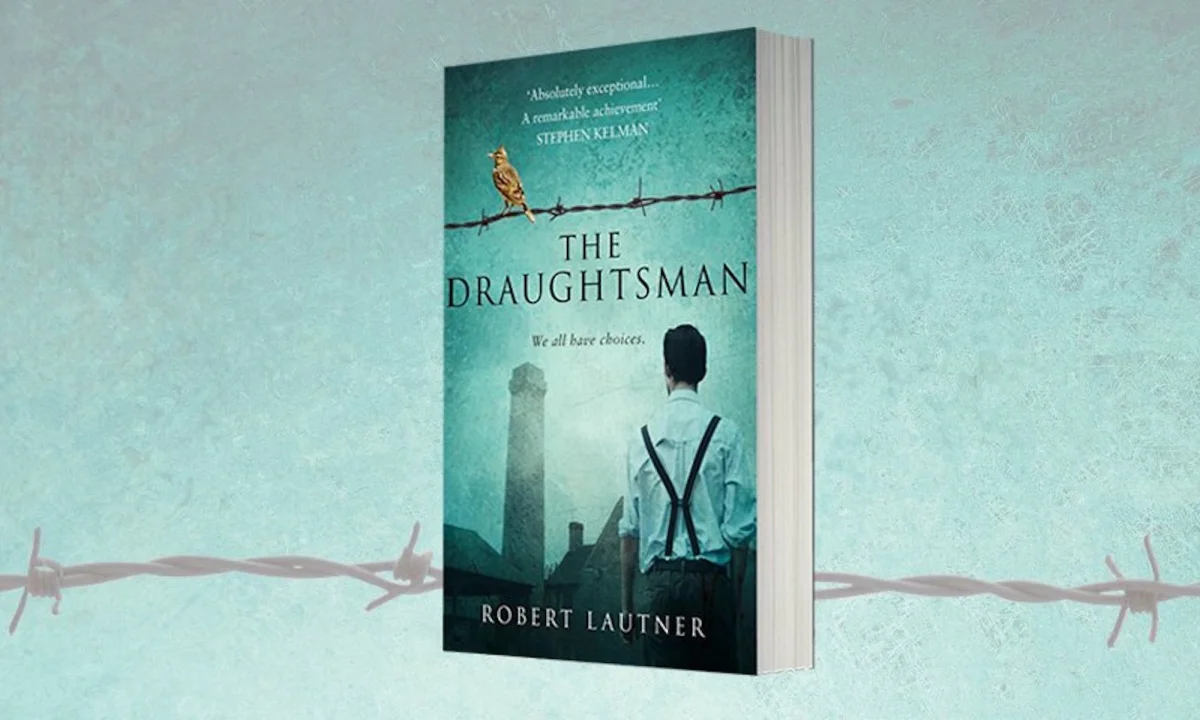
Before Quint there was the pandemic. I didn’t write during that time. My last novel was published in 2018. The Draughtsman. I think I wrote it from about 2014 (when I was finishing Quint) and I think it was finished in 2016. It’s my largest book and I can’t reach up and grab it to check but it’s pretty thick looking at it from here.
I’m proud to say it was very well received and was shortlisted for the Walter Scott Historical fiction prize. But it was a difficult book to categorize.
I suppose it fits into the “Good German” narrative, by which I mean it centred on a man who helped design the ovens for the concentration camps but wasn’t evil himself. He was doing his job. When I look at it now it feels like I didn’t write it, it feels like it was written decades ago and, admittedly it’s written in a strange staccato style as if translated from the German directly without correcting syntax or sentence structure which makes it a studious read. It might become the book I leave behind. I’ve since found out it has made its way into some university courses (but then someone also did their thesis on my pirate novels which was a bit weird). But the subject is just that wrong side of being comfortable enough and not sentimental or maudlin enough to warrant huge success. It feels just pathetic enough to be true.
Before that came The Road To Reckoning (which I wanted to call The Wooden Paterson but it was changed). This was the book which got me noticed as a more “literary” writer rather than writing adventure. Although it’s often called a Western the story never gets out of Pennsylvania and is set in 1836. It’s the only book I’ve had optioned for a movie and the first one written as Robert. It’s one of those stories (and it is a story in the purest form) that you can give to your children and your parent and they’ll both get something out of it. I’ve had nothing but praise from it. It’s fucking amazing.
Before that I was writing my Pirate Devlin novels, four in total but more were planned, and I might finish them one day. Devlin was the first book I ever wrote and I didn’t have a drawer full of other unpublished work. The Devlin novels are the only ones where I get actual letters from fans all over the world, actual mail, and this amazes me that readers are willing to put pen to paper and seek me out. Mostly because I treated pirates as they were and not as a fantasy (my initial passion was to write against the Disney supernatural approach from the movies) and because pirates can be so well used to reflect a very modern anti-establishment philosophy and rhetoric for today’s society. Pirate fans are very much a sub-culture. I was a punk and a Goth when I was younger and I guess I never grew out of it. Piracy is in my blood, although I’m not as angry as I used to be, thankfully.
Anyway, that’s me shouting out my other work. Take a look. I need the money.
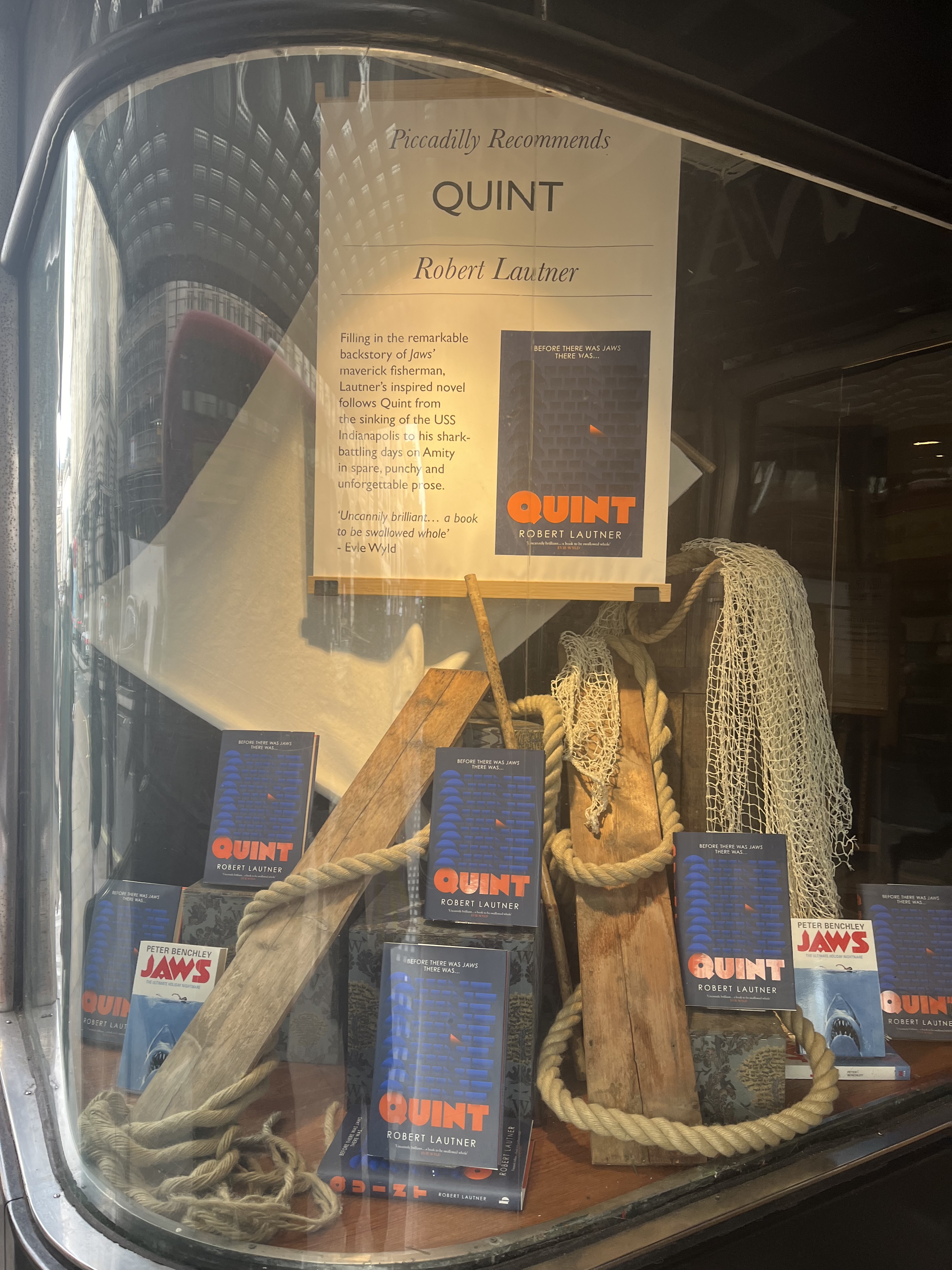
Quint has been out for about three weeks now and the response has been amazing. The book got a prime window in Waterstone’s flagship store in Piccadilly and they give it great backing from their booksellers naming it their book choice. The Times announced it as their Book Of The Month (that blew me away) and the Irish Independent called it a “literary miracle”.
Audio and electronic sales have been good, the book sales the best I’ve ever had for a hardback and the critical reviews are better than I could have imagined. I ventured to London for a book signing and was featured on BBC Radio 4 and RTE Radio One. Thank you to everyone who bought a copy! For a book that’s had very little publicity I’m very proud of its reception.
Waterstone’s asked me to do a piece for their blog and it was then that I had to go back in time and drag through my emails to find out when I had actually written the book.
Weirdly enough, and to my own surprise, I had told my agent about it first in 2012! By that time, I told him, I was a third of the way through and we put it to HarperCollins in 2013 and signed the contract in 2014 as part of a two-book deal with a publication date of 2019.
ISBN’s were created, publication announced, a placeholder with random details and page numbers put up on Google all ahead of time. Then the lawyers stepped in and publication stopped.
After many years the Benchley estate decided the time was right to allow other works related to JAWS to go ahead and we got our permission in 2022 to publish for the 50th anniversary of JAWS in Feb 2024. And he we are.
An annoying thing is that I’ve had people import the book to the US (and tell me so) because as yet there is no set US release and that has confused some. Yes, despite being available in Canada, Australia and the rest of the world, Quint doesn’t have a US release yet.
Yet.
And I’m not allowed to say why. I may even get into trouble for talking about it. Let’s be mysterious enough and say that I know the reason.
I might be able to say a couple of words and that should be OK. Hopefully.
Universal. Fiftieth.
That should do.
What I’m saying (and not saying) is just as the timing for the hardback was for the 50th anniversary of the novel there are powers that decide these things outside myself and publishers and they have many sleeves with many cards up them. Timing is everything.
Once again I have been entirely neglectful of this page, but now the year is ending and my thoughts turn to writing again.
My only real pieces of news this year are (one) that we decided to let out our cabin on AirBnB. The plan was that we wanted to do some renovations (we have lived in the place for about eight years and it needed a spruce) so we thought we’d move out and do it up and, to earn some money to help with the work, we’d let it out on AirBnB thinking that only one or two people would come and it might be fun. And then people started to book. And then they kept booking and kept booking and booking.
Within a few weeks of listing our chalet was fully booked for the season. This was great but it meant we couldn’t do the painting and decorating we’d planned. But the whole AirBnB thing was really enjoyable and we met some lovely people (some of whom are coming back!) and we’re really thinking of making a full-time business out of it because it was such an experience.
I live here!
The second thing was because of the AirBnB thing I haven’t been able to finish a novel this year, but I do have two unpublished manuscripts (one of which was rejected, the other never presented) so I thought I’d publish them on Amazon.
I’ve never done it before but I didn’t want to wait two years for a publisher’s schedule to catch up. I just wanted to get them out there.
Unfortunately I found it really difficult, exhausting even, to get my head around the formatting for the kindle programme but, eventually, I got something reasonably acceptable.
Now, I haven’t done anything to promote the first book (and haven’t put the second up) as I thought I’d leave that for 2020 so I’m going to start whispering about it.
The main change for this book is that I’ve published it under my own name, Mark Keating, rather than Robert Lautner. Strangely enough I did this because Mark Keating is less well known and I wanted to re-establish him…me?…as a writer again. I don’t know. But if anyone can advise how to promote Amazon books that would be great.
Here’s the UK and US Amazon links for Rabbit Moon.






 robertlautner