The Shark is Still Working

I was on BBC Radio 4’s Front Row the other day, which is one of their cultural arts programmes, as they’d invited me as part of a segment on JAWS. what with the whole 50th thing coming.

https://www.bbc.co.uk/programmes/m00208gp

It was only brief and we were talking about shark movies in general and the legacy of JAWS in that regard what with two summer shark movies being released (Under Paris and Something in the Water).

It made me think of what is the actual legacy of JAWS?

There are probably quite a few TBF, ranging from the impact on the blockbuster as a genre to the marketing and crafting of movies, but I wanted to consider one perhaps less obvious, and personal, either individually or as a group.

As an older JAWS fan I can see how the movie has grown with me over the years and how it resonates with different ages from perspective.

When you’re a kid it’s certainly a horror movie. I was lucky enough (or unlucky at the time) to see JAWS in the cinema, although I hid behind a seat for most of it.

Then, as a teen, it becomes a summer movie, an escapism, something fast consumed with action and heroes and a (literally) explosive ending, a satisfying not too “deep” watch before dinner that gets the adrenaline flowing in a not too intense manner. You enjoy it for its surface and it doesn’t mess you around or cheat you.

Then, as you get older you can see more into it. JAWS grows with you. As an adult you’ve watched thousands of movies by now and you begin to appreciate the crafting of the film, particualy Verna Fields editing, the dialogue and the humour, the characters and their arcs.

To many of us JAWS was the movie where (if we’d grown up with it) we learned to discern movies. Instead of just munching on any old dross they would chuck out for kids we began to notice what made films good or bad.

It was subtle but somehow JAWS pervaded us with its delicate approach and its use of camera and music, of shooting angles, sound, light and composition, enough that we could now see where all this was lacking in other films and subconsciously acknowledge when we saw it in a film, which could have eluded us if we didn’t have this burned in appreciation of JAWS in our psyche.

As I’m writing the film that immediately comes to mind is Marathon Man (which I’ve just looked up was ‘76 and it probably just popped in because of Roy).

Again I would have seen this on the TV as a kid but could immediately tell as I watched that this was a “good” movie. And I can see JAWS in it. Do you know what I mean? You can spot it. I think JAWS did that for us, some of us at least.

In the piece on the radio the presenter, Antonia Quirke who has written a BFI Classics book on JAWS, delighted me when she said how JAWS seems to have always been with her, that she couldn’t remember a time when JAWS wasn’t around. I know what she means. It’s almost like JAWS is always still lurking near every movie you watch, that without even considering it, the shark is still working on us, circling silently. The landlord of film, getting his rent due.

What else has he written?

I read recently, from a blogger, how authors need to talk about their old books, or perhaps their “previous” books is a better way of looking at it, because their publishers sure as hell won’t. I never thought about this before but it’s true. To your publisher the most important book is your last, the one out now, so the only person who’s going to talk about your other work is you. They have a point.

I often think about my work as done and done. I’m always concentrating on the next. The past is past, but I also should consider selling my old work too. I’m proud of it, it’s good stuff and it took years of my life to do. So I’m reflecting now.

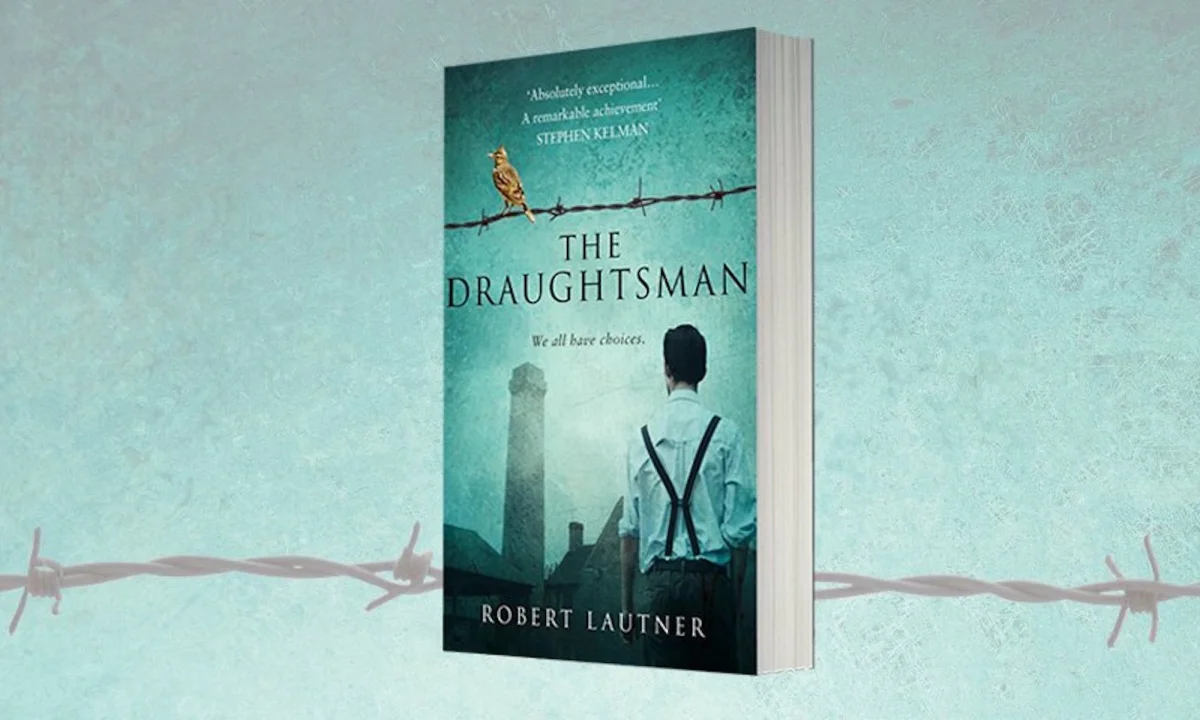
Before Quint there was the pandemic. I didn’t write during that time. My last novel was published in 2018. The Draughtsman. I think I wrote it from about 2014 (when I was finishing Quint) and I think it was finished in 2016. It’s my largest book and I can’t reach up and grab it to check but it’s pretty thick looking at it from here.

I’m proud to say it was very well received and was shortlisted for the Walter Scott Historical fiction prize. But it was a difficult book to categorize.

I suppose it fits into the “Good German” narrative, by which I mean it centred on a man who helped design the ovens for the concentration camps but wasn’t evil himself. He was doing his job. When I look at it now it feels like I didn’t write it, it feels like it was written decades ago and, admittedly it’s written in a strange staccato style as if translated from the German directly without correcting syntax or sentence structure which makes it a studious read. It might become the book I leave behind. I’ve since found out it has made its way into some university courses (but then someone also did their thesis on my pirate novels which was a bit weird). But the subject is just that wrong side of being comfortable enough and not sentimental or maudlin enough to warrant huge success. It feels just pathetic enough to be true.

Before that came The Road To Reckoning (which I wanted to call The Wooden Paterson but it was changed). This was the book which got me noticed as a more “literary” writer rather than writing adventure. Although it’s often called a Western the story never gets out of Pennsylvania and is set in 1836. It’s the only book I’ve had optioned for a movie and the first one written as Robert. It’s one of those stories (and it is a story in the purest form) that you can give to your children and your parent and they’ll both get something out of it. I’ve had nothing but praise from it. It’s fucking amazing.

Before that I was writing my Pirate Devlin novels, four in total but more were planned, and I might finish them one day. Devlin was the first book I ever wrote and I didn’t have a drawer full of other unpublished work. The Devlin novels are the only ones where I get actual letters from fans all over the world, actual mail, and this amazes me that readers are willing to put pen to paper and seek me out. Mostly because I treated pirates as they were and not as a fantasy (my initial passion was to write against the Disney supernatural approach from the movies) and because pirates can be so well used to reflect a very modern anti-establishment philosophy and rhetoric for today’s society. Pirate fans are very much a sub-culture. I was a punk and a Goth when I was younger and I guess I never grew out of it. Piracy is in my blood, although I’m not as angry as I used to be, thankfully.

Anyway, that’s me shouting out my other work. Take a look. I need the money.

After publication. The first month.

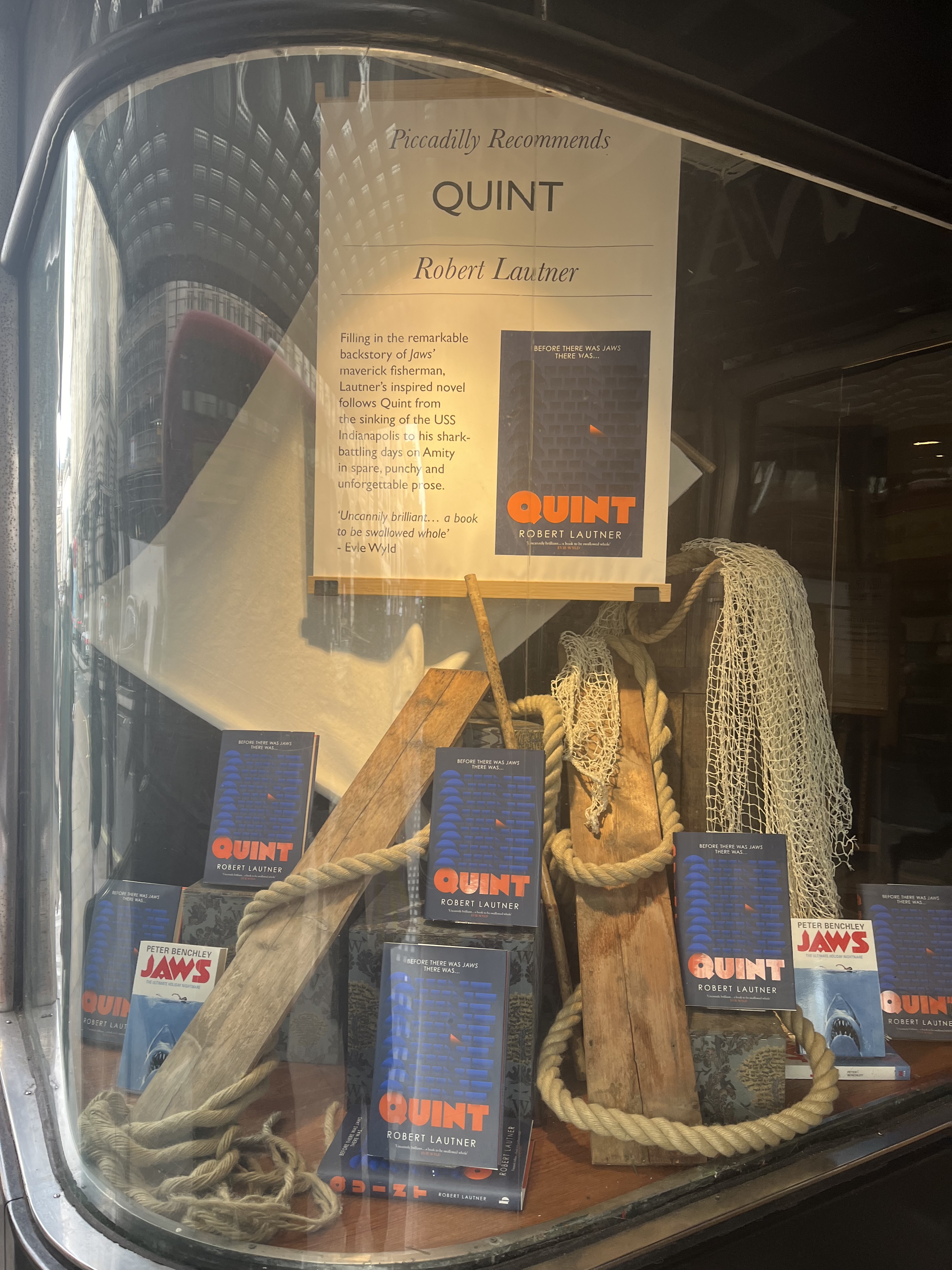
Quint has been out for about three weeks now and the response has been amazing. The book got a prime window in Waterstone’s flagship store in Piccadilly and they give it great backing from their booksellers naming it their book choice. The Times announced it as their Book Of The Month (that blew me away) and the Irish Independent called it a “literary miracle”.

Audio and electronic sales have been good, the book sales the best I’ve ever had for a hardback and the critical reviews are better than I could have imagined. I ventured to London for a book signing and was featured on BBC Radio 4 and RTE Radio One. Thank you to everyone who bought a copy! For a book that’s had very little publicity I’m very proud of its reception.

Waterstone’s asked me to do a piece for their blog and it was then that I had to go back in time and drag through my emails to find out when I had actually written the book.

Weirdly enough, and to my own surprise, I had told my agent about it first in 2012! By that time, I told him, I was a third of the way through and we put it to HarperCollins in 2013 and signed the contract in 2014 as part of a two-book deal with a publication date of 2019.

ISBN’s were created, publication announced, a placeholder with random details and page numbers put up on Google all ahead of time. Then the lawyers stepped in and publication stopped.

After many years the Benchley estate decided the time was right to allow other works related to JAWS to go ahead and we got our permission in 2022 to publish for the 50th anniversary of JAWS in Feb 2024. And he we are.

An annoying thing is that I’ve had people import the book to the US (and tell me so) because as yet there is no set US release and that has confused some. Yes, despite being available in Canada, Australia and the rest of the world, Quint doesn’t have a US release yet.

Yet.

And I’m not allowed to say why. I may even get into trouble for talking about it. Let’s be mysterious enough and say that I know the reason.

I might be able to say a couple of words and that should be OK. Hopefully.

Universal. Fiftieth.

That should do.

What I’m saying (and not saying) is just as the timing for the hardback was for the 50th anniversary of the novel there are powers that decide these things outside myself and publishers and they have many sleeves with many cards up them. Timing is everything.

The Head. The Tail. The Whole Damn Thing.

It’s now just under seven months to go for publication of my novel based around Quint from JAWS. That seems like a long time but not when you’ve been waiting about eight years for it to exist at all.

So Feb 2024 will come around to line up with the 50th anniversary of Peter Benchley’s original novel and then the paperback will follow in 2025 for the 50th of the film. We’ll see what happens to my high hopes then.

I’d like to get some thoughts down on what this book actually is and its purpose.

I write literary fiction, whatever that actually is, but I suppose it means that there are certain sensibilities and themes you don’t find in other genres, a reading experience that fulfils differently.

I write what I want to write. Anyone could write a book about Quint. All you need to do is check all the boxes. USS Indianapolis? Check. Sharks? Check. The Orca? Check. And so on. That’s a book, sure. But that’s not a story.

And most would concentrate on the Indianapolis as the engine for the story. That’s the event, right? That’s what Quint’s all about, right?

That’s lazy. It’s the same trap that filmmakers fall into whenever there’s been an attempt to tell the story of the tragedy. They feel the event is enough, that the action is the drama, is the story. And they fail.

Mostly they fail because we know the story, know it’s tragic and terrible. We know. What else you got?

Obviously I wrote this book from a deep affection for JAWS. The film has been a constant in my life. And what appeals to most fans is the mystery of Quint, and, in contradiction almost, it’s that mystery which makes the character. He doesn’t need a past, all we need to know about him is in the film so, in effect, writing a novel about the character is almost sacrilegious to the mystery. It shouldn’t be done.

So I didn’t look at it like that. I wrote a novel that could actually be about anyone. Anyone that is who had three wives, grew up in the depression, went to war, survived the sinking of a battleship and became a charter captain specialising in shark fishing. And it’s also none of those things. It’s a character story and journey. You can take it as a story about Quint when you pick it up but it won’t be when you finally close it.

I have chosen the non-profit organisation “Beneath The Waves” for charitable donations from myself and the publisher on publication and future royalties. You can help support them.

https://beneaththewaves.org/

Quint 1st edition hardbacks are available for pre-order.

https://smarturl.it/Quint-HB